

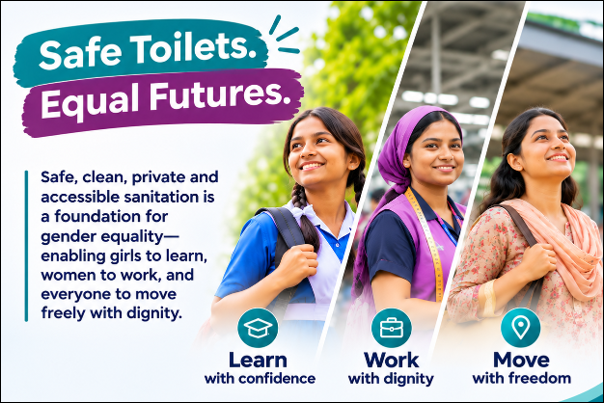
The
Invisible Barrier to Women's Equality
Imagine a schoolgirl avoiding drinking water throughout the
school day because the toilets are inadequate, a female worker struggling to
manage menstruation without privacy at her workplace, or a woman avoiding
public spaces because safe toilets are unavailable. These are not isolated
sanitation problems; they represent barriers to women's education, economic
participation, mobility, and dignity.
Such experiences highlight an often-overlooked dimension of
gender inequality: access to safe, private, clean, and functional sanitation
facilities. Women's empowerment is frequently discussed in terms of education,
employment, financial independence, and participation in decision-making. Yet,
these opportunities can be undermined by something as fundamental as the
absence of an appropriate toilet. In Bangladesh, where women's participation in
education and the economy has expanded significantly, gender-responsive
sanitation remains an important but often overlooked foundation for equality. A
toilet is therefore more than infrastructure; it is an essential condition for
dignity, opportunity, and independence.
One
Issue, Three Environments: Where Sanitation Shapes Women's Lives
At School: When
Sanitation Influences a Girl's Educational Journey
A supportive learning environment requires more than
classrooms, teachers, and educational materials. Girls also need separate,
safe, clean, and functional toilets, adequate water, soap, privacy, and appropriate
menstrual hygiene facilities. When these essential services are unavailable,
menstruation can become a source of anxiety, discomfort, and absenteeism.
According to UNICEF and WHO (2022), approximately 43% of
schools in Bangladesh lacked basic sanitation services, including
gender-segregated toilets with privacy. UNICEF Bangladesh has also reported
that approximately one in three adolescent girls missed school for a few days
each month during menstruation (UNICEF, 2022). These findings highlight the
importance of integrating menstrual hygiene management into school WASH
programs through functional facilities, disposal arrangements, access to
menstrual materials, and age-appropriate health education.
The implications extend beyond school attendance. When girls
cannot manage their hygiene needs comfortably, their confidence, participation,
and learning experiences may also be affected. Ensuring safe and
gender-responsive sanitation in schools is therefore an investment in girls'
educational continuity and future opportunities.
At Work: When Sanitation
Becomes an Economic Empowerment Issue
Women's participation in the workforce is essential to
economic growth and household well-being. However, employment opportunities
must be supported by working environments that protect women's health, safety,
and dignity. Inadequate workplace sanitation can create particular difficulties
for women managing menstruation, pregnancy-related needs, and personal hygiene
during working hours.
Bangladesh's Ready-Made Garment (RMG) sector provides an
important context for this discussion, given women's substantial contribution
to the industry. The Bangladesh Labour Act 2006, particularly Section 59,
requires establishments to provide sufficient sanitary toilets and washrooms,
separately for male and female workers, with adequate lighting, ventilation,
continuous water supply, and proper cleanliness. The Bangladesh Labour Rules
2015 further establish requirements concerning the number, location, and
maintenance of toilets, including covered waste bins in women's toilets.
However, compliance should not be assessed solely by the
existence of separate toilets. Facilities must remain functional, clean,
accessible, adequately supplied, and available without unreasonable
restrictions on toilet breaks. Employers should also ensure appropriate
menstrual hygiene arrangements and mechanisms for workers to raise
sanitation-related concerns. Gender-responsive workplace sanitation is an
essential component of decent work, occupational well-being, and women's
long-term economic participation.
In Public Spaces: When
Sanitation Determines Freedom and Mobility
Women's access to public spaces is closely connected to the
availability of safe and hygienic public toilets. Markets, transport terminals,
railway stations, parks, commercial areas, and other public facilities should
accommodate the sanitation needs of all users. Yet, inadequate availability,
poor maintenance, insufficient lighting, lack of privacy, and safety concerns
can make public toilets inaccessible or unsuitable for women.
A 2025 WaterAid Bangladesh study, Women on the Go,
involving 865 urban women in Dhaka and Chattogram, revealed the health and
mobility implications of this problem. Nearly 69% of respondents reported
reducing their water intake while outside their homes, while another 15%
avoided drinking water altogether because of inadequate access to safe public
toilets (WaterAid Bangladesh, 2025). Such coping practices can contribute to
dehydration, urinary health problems, and physical discomfort.
The consequences extend beyond health. Women may shorten
journeys, avoid certain locations, or limit their participation in public
activities because suitable sanitation facilities are unavailable. Women with
disabilities, older women, pregnant women, and caregivers may face additional
barriers. Safe, affordable, accessible, and well-maintained public toilets are
therefore essential to creating inclusive cities and enabling women's freedom
of movement.
The
Deeper Inequality: Who Gets Left Behind?
Sanitation inequalities do not affect all women equally.
Women from low-income households, informal settlements, rural and
climate-vulnerable communities often face greater barriers to accessing safe
facilities. Women with disabilities may encounter toilets that are physically
inaccessible, while older women and pregnant women may require additional
support and appropriate design features.
These overlapping disadvantages demonstrate the importance
of an intersectional approach to sanitation planning. Gender must be considered
alongside poverty, age, disability, occupation, and geographical location. A
genuinely inclusive sanitation system must recognize the diverse needs of women
rather than treating them as a single, homogeneous group.
Rethinking
Sanitation: From Infrastructure Provision to Women's Empowerment
Addressing these challenges requires moving beyond counting
the number of toilets constructed towards assessing whether facilities are
safe, functional, accessible, and responsive to users' needs. Schools,
employers, local authorities, and infrastructure developers should prioritize
gender-responsive design, menstrual hygiene management, regular cleaning,
adequate water and soap, appropriate disposal arrangements, and accessibility
for persons with disabilities.
Equally important is women's meaningful participation in the
planning, design, management, and monitoring of sanitation facilities.
Accessible feedback and grievance mechanisms can help institutions identify
shortcomings and improve service quality. Sustainable financing and clear
operation and maintenance responsibilities are also essential to ensure that
facilities remain usable over time.
The Role
of Development Planning and Social Safeguards
Development projects have an important role in addressing
sanitation-related inequalities. Gender analysis, social impact assessments,
stakeholder engagement, and social management planning can help identify
barriers faced by women and vulnerable groups and integrate appropriate
mitigation measures into project design and implementation. Monitoring should
assess not only infrastructure delivery but also accessibility, functionality,
safety, user satisfaction, and meaningful participation. Integrating these considerations
into development planning can help ensure that infrastructure investments
generate equitable and sustainable social outcomes.
Conclusion:
A Future Where Sanitation Does Not Limit Women's Opportunities
Women's empowerment requires more than providing
opportunities; it requires removing the everyday barriers that prevent women
from accessing them. Safe sanitation enables girls to pursue education with
dignity, women to participate in employment without compromising their health,
and everyone to access public spaces with greater confidence and independence.
Bangladesh's development priorities must therefore recognize gender-responsive
sanitation as an essential component of inclusive growth and social
sustainability. When sanitation supports women's dignity, safety, and
independence, it becomes more than infrastructure; it becomes an investment in
a more equal society.
References
Bangladesh Labour Act, 2006 (Act
No. XLII of 2006). (2006). The Ministry of Law, Justice and Parliamentary
Affairs.
UNICEF. (2022). School girls in
Bangladesh learn that periods are nothing to be ashamed of. UNICEF
Bangladesh. https://www.unicef.org/bangladesh/en/stories/school-girls-bangladesh-learn-periods-are-nothing-be-ashamed
UNICEF, & World Health
Organization. (2022). Schools ill-equipped to provide healthy and inclusive
learning environments for all children [Press release]. UNICEF Bangladesh. https://www.unicef.org/bangladesh/en/press-releases/schools-ill-equipped-provide-healthy-and-inclusive-learning-environments-all
WaterAid Bangladesh. (2025). Women
on the go: How poor sanitation influences urban women's water intake in
Bangladesh. https://www.wateraid.org/bd/publications/women-go-how-poor-sanitation-influences-urban-womens-water-intake-bangladesh
Share this page via